Showing posts with label App Developers.. Show all posts

Thursday, September 4, 2014

Why Android Apps Developers Give Up Easily?


Android’s growing popularity has clearly had a positive effect on the quantity and quality of goods in Google’s app market. Even though about 80 % of new smartphones is being run on Android for the sake of vastly larger theoretical customer base- this isn’t working anymore.

Here’s the thing: “Android’s Gain Has Not Been IOS‘s Loss”.

iPhone users are pretty much assume that any major app that wouldn’t be nixed by Apple’s App Store policies will offer future updates at least as early as anyone else.

Whereas, in case of Android phone, you’ll get most major apps but there are exceptions.
A few factors which help explain why iOS keeps its app edge or in other words why Android app developers give up so easily:

Attractive: There are plenty of stats saying that iOS users are more app-happy and free-spending than Android users. That makes iOS a more attractive market despite the fewer bodies.

Supporting Multiple Platforms Is Tough: Many interesting apps come from tiny start-ups that pretty much don’t have the option of releasing two ambitious pieces of software simultaneously. This makes it much tougher for Android to have a shot at pulling even with iOS.

Developing for Android is a hassle: One obstacle in Android app development is the challenge of supporting a bevy of devices from different manufacturers and running different variants of the operating system.

Android Versions Aren’t Quick: What if the second platform a developer supports is the iPad? As in like the e-mail app Mailbox which was originated on the iPhone but later arrived in a version nicely rethought for the iPad’s larger display. Later, after a year or so, even an Android version came as a to-do list item for Mailbox’s creators.

In the U.S., Android isn’t the runaway market-share champ. For instance, Android has 51.5 percent share and iOS has 41.8 percent. This inconvenient truth for anyone who argues that Apple’s operating system is on an inexorable march towards irrelevance.

Thursday, May 29, 2014

How Do I Choose Between Native and Hybrid App Development?

Are you looking to invest in a mobile app for your company? The first odd would be the barrage of terminology. Say for instance, what are native and hybrid mobile apps? And which is most appropriate for your business?

In this article, we shall highlight the key points in choosing the right mobile application solution for your business needs. 

Native App

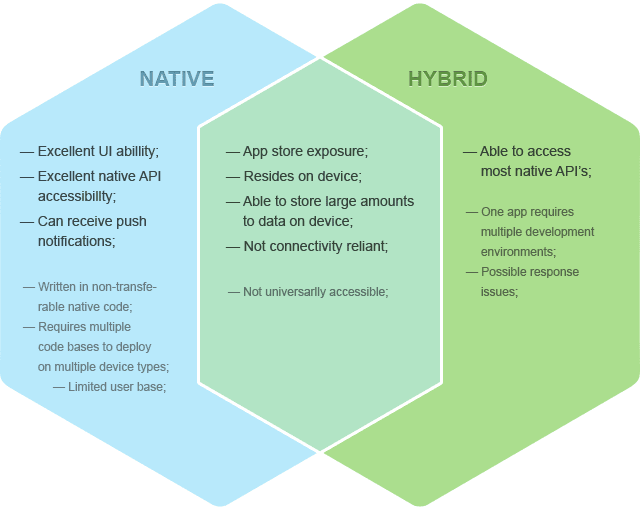
Native apps are ones built to work optimally with a particular Smartphone operating system, be it iOS (Apple), Android or Windows 8. Later, users get it downloaded in their respective device type from an app store. There are a lot of positives with native apps.

·         The Best Performance (esp. with UI concerns)
·         Full Access to Device/Platform/APIs
·         App Store Discoverability

The code is written for a specific device and tends to be most expensive-to-develop. If you wanted to see consistent revenue, this is the right choice. However, those looking to establish their brand must have a different choice, Hybrid App Development.

Hybrid App Development

A hybrid app is a native mobile app installed through an app store but is written primarily using HTML, CSS and JavaScript instead of using the native SDK. Since it utilizes many of the same skills necessary to create a mobile website, perhaps this is an attractive option for the web developers to leverage those skills immediately.

Why Does Building A Hybrid App Makes Sense?

There are many reasons why building a hybrid application makes sense.
Hybrid apps use the native SDK to wrap the web app making discovery and distribution easier for users. PhoneGap or Titanium App Development makes the process simpler, saving time. If you already have an existing web app or code base, building a hybrid app is typically faster than writing an app using the native SDK, and because of the ability to share code between platforms, significant time is saved through code reuse.


Still you aren’t sure of what to choose? Approach a mobile app development company, NYC like Openwave Computing LLC, who has experts working on both the nodes.